The Role of Analytical Testing in Botanical Extract Manufacturing

Why Science Defines the Future of Botanical Ingredient Quality
The botanical extract industry has evolved significantly over the past few decades.
Traditional knowledge has introduced the world to the potential of natural ingredients, but modern nutraceutical manufacturing requires something more: precision, consistency, and scientific validation.
As global demand for botanical ingredients continues to grow, nutraceutical brands are becoming increasingly focused on quality assurance. They are not only looking for effective ingredients but also for confidence that every batch meets defined standards for identity, potency, purity, and safety.
This is where analytical testing plays a fundamental role.
Analytical testing is not simply a final quality check. It is an integrated part of botanical extract manufacturing that ensures reliability throughout the entire production process.
The Challenge of Natural Ingredient Variation
Unlike synthetic ingredients, botanical extracts originate from natural sources. This creates unique quality challenges.
Factors such as:
- Geographic origin
- Soil conditions
- Climate variations
- Cultivation practices
- Harvesting methods
- Processing techniques
can influence the composition of plant materials.
Without proper testing and validation, variations in active compounds may affect the consistency and performance of the final ingredient.
For nutraceutical manufacturers, maintaining predictable quality is essential. A standardized botanical extract must deliver the same level of quality from one production batch to the next.
Analytical testing provides the scientific foundation needed to achieve this consistency.
HPLC: Measuring Active Compounds with Precision
High Performance Liquid Chromatography (HPLC) is one of the most widely used analytical techniques in botanical extract manufacturing.
HPLC enables manufacturers to accurately identify and quantify specific bioactive compounds within an extract.
For ingredients such as Curcumin and Bacopa, HPLC plays an important role in verifying:
- Active compound concentration
- Standardization levels
- Ingredient authenticity
- Batch-to-batch consistency
For example, in curcumin extracts, HPLC helps measure individual curcuminoid profiles. In Bacopa extracts, it supports the evaluation of bacoside levels.
This level of analytical precision allows manufacturers and nutraceutical brands to work with greater confidence.
GC Analysis: Ensuring Safety and Purity
Gas Chromatography (GC) is another important analytical method used within botanical ingredient testing.
GC analysis is commonly applied to evaluate volatile compounds and monitor parameters such as residual solvents.
During botanical extraction, solvents may be used to efficiently separate desired compounds from plant materials. Proper control and removal of these solvents are essential to ensure ingredient safety and compliance.
GC testing helps manufacturers confirm that botanical extracts meet required safety standards before reaching customers.
For international nutraceutical markets, these quality checks are becoming increasingly important during supplier evaluation.
UV Analysis and Supporting Quality Evaluation
UV-Visible spectroscopy is another analytical technique used in botanical manufacturing.
It helps measure specific compounds based on their ability to absorb ultraviolet or visible light.
UV analysis can support:
- Identity verification
- Quality assessment
- Routine monitoring
- Process control
When combined with advanced analytical methods, UV analysis contributes to a comprehensive quality evaluation system.
Each testing method provides valuable information, creating a complete understanding of ingredient characteristics.
Testing Throughout the Manufacturing Process
Quality is not created only at the final testing stage.
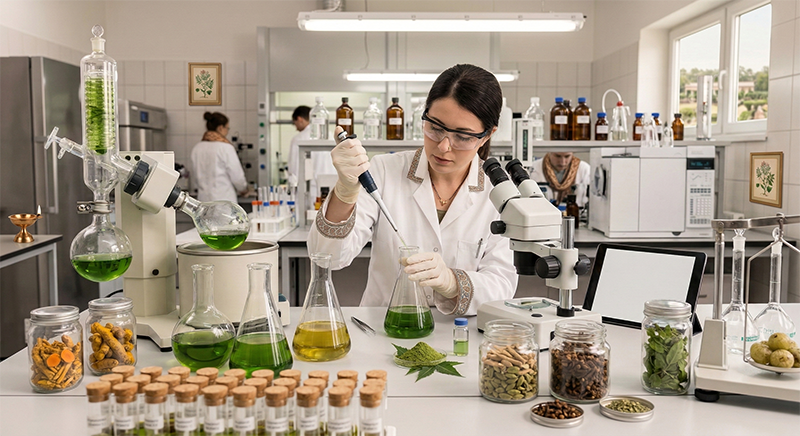
Professional botanical extract manufacturers integrate analytical testing throughout the manufacturing lifecycle.
This includes:
Raw Material Testing
Before extraction begins, raw materials are evaluated to confirm identity, quality, and suitability.
In-Process Monitoring
During manufacturing, testing helps monitor process performance and maintain consistency.
Finished Product Testing
Final analysis confirms that the finished extract meets established specifications for:
- Identity
- Potency
- Purity
- Safety
- Regulatory requirements
This complete approach ensures that every batch maintains the expected quality standards.
Building Trust Through Transparency
For modern nutraceutical brands, analytical documentation has become an essential part of supplier selection.
- Buyers increasingly expect access to:
- Certificate of Analysis (COA)
- Analytical reports
- Specification documents
- Safety testing results
- Quality compliance records
Transparent documentation allows brands to confidently develop products while meeting regulatory expectations. In a competitive global market, scientific transparency has become a major advantage for botanical ingredient manufacturers.
The Future of Botanical Quality Assurance
As the nutraceutical industry continues to expand, analytical testing will become even more important.
Future botanical manufacturing will depend on the combination of:
- Advanced analytical technologies
- Automated quality systems
- Data-driven manufacturing
- Strong regulatory compliance
- Scientific validation
The companies leading the botanical ingredient industry will be those that recognize quality as a continuous process rather than a final inspection.
Analytical testing transforms natural ingredients into trusted nutraceutical solutions by connecting botanical potential with scientific accuracy.
Because in the future of botanical manufacturing, trust will be built through measurable quality.